
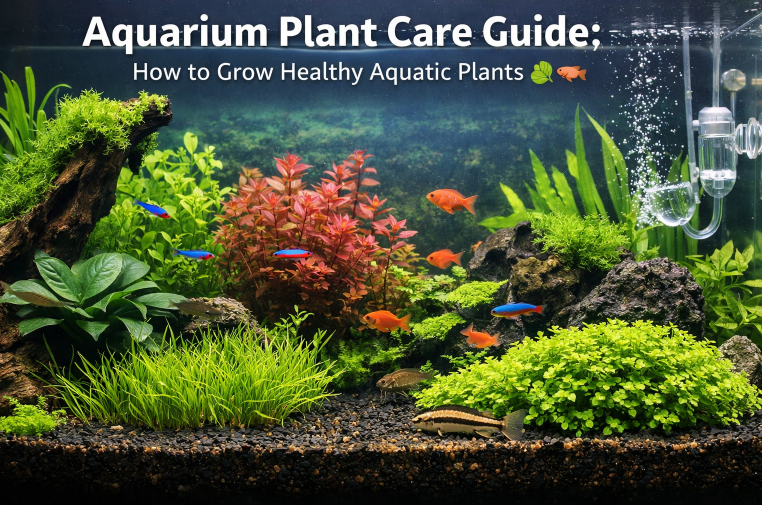
Aquatic plants are an essential part of a beautiful aquarium. They not only enhance the visual appeal of the tank but also help improve water quality, provide shelter for fish, and create a more natural ecosystem. However, many beginners encounter problems such as yellow leaves, melting plants, or slow growth. With the right knowledge and maintenance routine, growing healthy aquarium plants can be simple and rewarding.
This guide covers the key factors for successful aquatic plant care: lighting, nutrients, substrate, CO₂, and regular maintenance.
1. The Three Essential Factors for Plant Growth
Like terrestrial plants, aquatic plants require light, nutrients, and carbon dioxide (CO₂) to grow. These three factors must stay balanced.
Lighting
Lighting provides the energy needed for photosynthesis.
Recommended lighting conditions:
- Lighting duration: 6–8 hours per day
- For new tanks: start with 5–6 hours to prevent algae
- Use full-spectrum LED aquarium plant lights
Common lighting issues:
- Too little light → weak growth and pale leaves
- Too much light → algae outbreaks
Nutrients (Fertilization)
Aquatic plants require both macronutrients and micronutrients.
Macronutrients:
- Nitrogen (N)
- Phosphorus (P)
- Potassium (K)
Micronutrients:
- Iron (Fe)
- Magnesium (Mg)
- Manganese (Mn)
Nutrients are typically supplied through:
- Nutrient-rich substrate
- Liquid fertilizers
Common deficiency signs:
- Yellow leaves → possible iron deficiency
- Slow growth → possible nitrogen or potassium deficiency
Carbon Dioxide (CO₂)
CO₂ is a major factor in heavily planted aquariums.
Do you always need CO₂?
| Plant Type | CO₂ Requirement |
|---|---|
| Low-light plants (Java moss, Anubias) | Not necessary |
| Medium plants (Java fern, Cryptocoryne) | Optional |
| High-light plants (carpet plants, red plants) | Strongly recommended |
Most planted aquariums maintain 20–30 ppm CO₂ for optimal growth.
2. Choosing the Right Substrate
A good substrate provides stability and nutrients for plant roots.
Common substrate types:
Aquasoil
- Rich in nutrients
- Helps stabilize water parameters
- Ideal for planted aquariums
Gravel or sand
- More affordable
- Usually requires additional root fertilizer
For beginners, aquasoil is often the easiest option.
3. Beginner-Friendly Aquarium Plants
If you are new to planted aquariums, start with hardy species that are easy to grow.
Mosses
- Java Moss
- Christmas Moss
Low-light plants
- Anubias
- Java Fern
Foreground plants
- Dwarf Hairgrass
- Monte Carlo
These plants tolerate a wide range of conditions and require less equipment.
4. Regular Aquarium Plant Maintenance
Water Changes
Perform regular water changes to maintain stable water quality.
Recommended schedule:
-
Change 20–30% of the water every week
Trimming
Regular trimming helps maintain plant health.
Benefits include:
- Preventing plants from blocking light
- Encouraging bushier growth
- Improving overall aquascape appearance
Algae Control
Algae is a common challenge in planted tanks.
Ways to reduce algae growth:
- Control lighting duration
- Maintain balanced fertilization
- Perform regular water changes
- Introduce algae-eating species such as shrimp or algae-eating fish
5. Common Beginner Problems
Why are my plants melting?
Many plants experience “melting” when first introduced to a new aquarium. This is usually temporary as the plant adapts to new water conditions.
Why are my plants not growing?
Possible reasons include:
- Insufficient lighting
- Nutrient deficiencies
- Lack of CO₂
Why is algae growing in my tank?
Algae often appear when there is too much light combined with unbalanced nutrients.
Conclusion
Growing aquatic plants successfully comes down to maintaining balance between lighting, nutrients, and CO₂, along with consistent maintenance. Once these fundamentals are in place, your aquarium can become a thriving underwater ecosystem.
With time and experience, you can experiment with more advanced aquascaping techniques and create a stunning planted aquarium where fish and plants flourish together.